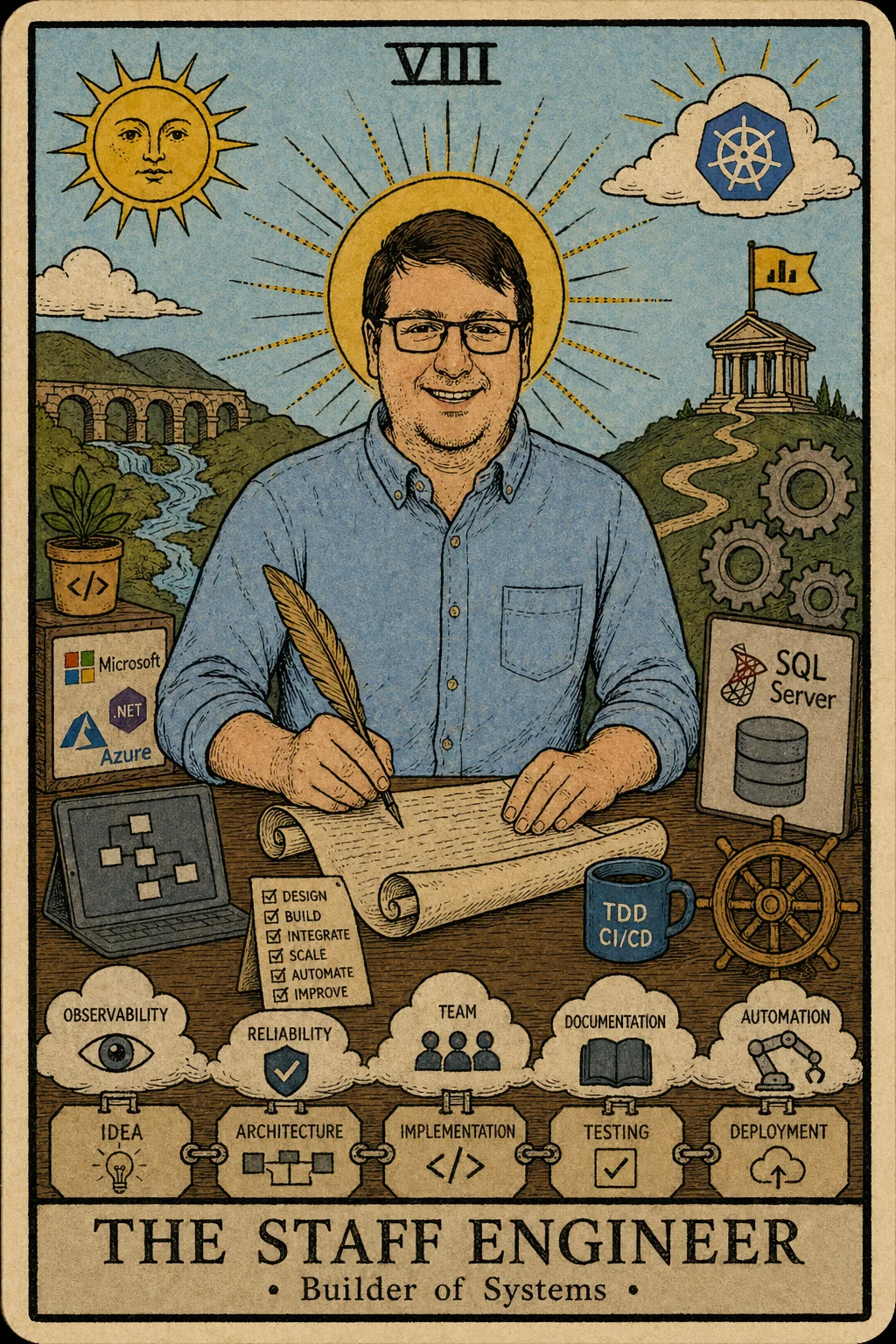
Tarot-style portrait of Matt Kraatz as The Staff Engineer, Builder of Systems.

Product Engineer · Nashville, Tennessee

Matt Kraatz

I build useful products and the systems that help teams ship them.

I connect business needs with technical decisions, from product planning and architecture to full-stack delivery. AI is central to how I work: I shape the codebase, standards, and feedback loops that let agents deliver maintainable software.

Two Halves of the Same Job

Build the Right Product

I work with business and product teams to understand the problem, make tradeoffs, and turn requirements into a practical plan. I carry that work through estimation, implementation, testing, rollout, and training.

Build the Software Factory

I shape the environment that makes delivery repeatable: architecture, engineering standards, agent workflows, automation, and CI/CD. The aim is faster product delivery with code that people and agents can understand, verify, and change.

Selected Work

Product / End-to-End Ownership

A New Claim Repricing Product

I specified and built a major claim repricing application from scratch: a frontend, an authoring backend, and a runtime service that processes claims. I designed the data model for complex contracted pricing scenarios, then led training and rollout.

From business requirements to a working product in use.

Product / Business Impact

Rework the Core Pricing Workflow

I independently delivered a refactor of our main claim repricing application, changing how claims route through networks and contracts. Extensive testing supported a launch with no reported bugs or regressions.

Approximately 3% increase in potential revenue.

Architecture / Developer Experience

Make a Distributed System Easier to Change

In an environment of two dozen-plus connected applications across cloud and on-premises systems, I spearheaded the move to a monorepo. Nx coordinates builds; pnpm and NuGet central package management consolidate dependencies. Moving internal packages to project references simplifies releases and creates a path to shared pipelines, code, and documentation.

The work includes aligning framework and package versions and tackling difficult upgrades, including IronPython 2 to 3. My architectural direction is simplification: consolidate services into modular monoliths where independent deployment adds more cost than value.

AI / Business Operations

Faster Medical Bill Entry

At ForzaCare, I designed and implemented an AI workflow that extracted structured data from medical bills, making bill entry 85% faster with improved accuracy.

As Associate Director of Data Solutions and Development, I also led the development of a new product spanning partner APIs, an operations frontend, and backend services, alongside responsibility for production systems and operational support.

AI applied to a measurable operational bottleneck.

Make Good Delivery Repeatable

I introduced shared agent skills across the organization to help teams adopt AI and use it more effectively. Those skills support a consistent workflow:

  1. Define the product specification.
  2. Translate it into a technical plan.
  3. Review the plan and its tradeoffs.
  4. Have an agent implement the plan.
  5. Review, test, and QA the output.
  6. Ship through deployment pipelines.

Unit and integration tests give agents useful feedback and reviewers evidence. I'm also implementing coverage monitoring and exploring mutation testing to understand how well our tests catch mistakes.

Documentation is part of that environment. I created skills and led an effort to capture architectural decisions, business rules, domain guides, glossaries, inline explanations, and runbooks. System diagrams and Mermaid workflows help connect knowledge spread across applications.

Hands-on with Claude Code, Codex, Copilot, Cowork, and Cursor, including autonomous agent loops and reusable skills.

Built on Industry Experience

I'm a Staff Engineer at Prime Health Services, with more than nine years in software development across healthcare, medical billing, cost containment, and workers' compensation. My roles have spanned team leadership, DevOps, product delivery, and ownership of production systems.

Before software engineering, I led sales operations: building processes, managing partner workflows, and turning business data into decisions. That experience shapes how I work with stakeholders today. I want to understand how the business runs, what slows people down, and where software can make a meaningful difference.
Engineering Judgment Still Matters